How Much Space Do You Need for an 800‑Watt Balcony Solar System?
Balcony solar systems—often called “plug‑and‑play solar kits”—have become one of the simplest ways for renters and homeowners to generate renewable energy without rooftop installations or large structural projects. But before choosing a system, one of the most important questions to answer is: Do you have enough space for the panels?
This guide will walk you step‑by‑step through how to measure your balcony railing, how much space an 800‑watt system typically requires, what to do if your railing isn’t suitable, and how to plan for patio placement as an alternative.
Why are we talking about an 800‑Watt System?
800‑watt systems are often the best choice because:
- Many regulations limit plug & play solar systems to 800-1200 watts
- An 800 watt system consists of two 400‑watt panels or four 200‑watt panels
- These panels are compact enough to fit on most balconies or patios
- The system still produces meaningful daily power (often 2–4 kWh/day depending on sun exposure)
Several common products—such as DOKIO 800W 2×400W panels and ECO‑WORTHY 800W modular kits—fall into this sizing category. [Balcony_So…iness_Plan | Word]
For planning purposes, a 400‑watt panel is roughly 39–42 inches (100–106 cm) wide and 65–70 inches (165–178 cm) tall, depending on the manufacturer. Four 200‑watt panels may require a similar total area, just divided into smaller sections.
1: Measuring Your Balcony Railing
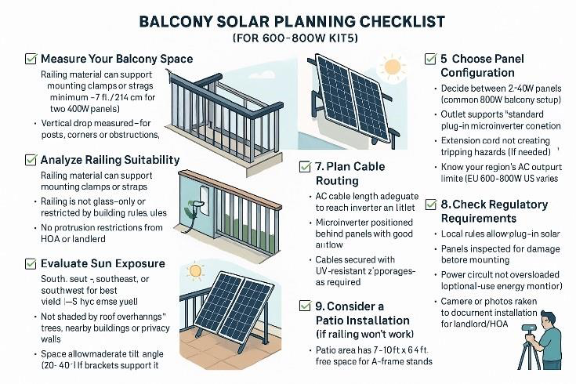
To determine how much solar your balcony can accommodate, you will measure horizontal railing length, vertical railing height, and mounting depth or clearance.
Step 1: Measure Horizontal Railing Length
Horizontal length determines how many panels can be mounted side‑by‑side.
- Take a measuring tape and start at the far left side of the railing.
- Measure straight across to the far right.
- If your railing is segmented, measure each segment individually.
- Write down the usable length—subtracting space taken by corners, posts, or dividers.
Example:
If your railing measures 10 feet (305 cm) end‑to‑end, and each 400‑watt panel is ~3.3 feet (100 cm) wide, you can fit two panels comfortably with room to spare.
Minimum horizontal length for an 800‑watt system
- Two 400‑watt panels: at least 7 ft (214 cm)
- Four 200‑watt panels: at least 9 ft (275 cm)
Step 2: Measure Vertical Railing Height
Vertical clearance ensures the panels can hang securely and safely without touching the ground.
- Measure from the top rail down to the balcony floor.
- Check whether there is an interior lip that could block panel overhang.
- Remember you must account for mounting brackets, which add 2–4 inches (5–10 cm).
Minimum vertical height needed
- Most 400‑watt panels require 65–70 inches (165–178 cm).
- Balcony railings are typically 36–42 inches high, meaning panels will extend below the railing and hang down.
This is normal and expected for balcony installations.
Step 3: Check Mounting Depth and Clearance
Depth clearance matters when your balcony space is tight.
- Panels typically protrude 1.5–2 inches (4–6 cm) from the railing.
- Microinverters add another 1–3 inches (3–8 cm) behind the panel.
Be sure that:
- The panels do not obstruct doorways,
- They do not violate building rules regarding outward protrusions,
- They won’t swing in wind due to insufficient support.
2: Determining Total Panel Area for an 800‑Watt Railing Installation
Below is a typical real‑world panel size breakdown:
Option A: Two 400‑Watt Panels
- Width: 39–42 in (100–106 cm) each
- Height: 65–70 in (165–178 cm)
- Total horizontal requirement: 78–84 in (200–212 cm)
Option B: Four 200‑Watt Panels
- Width: 25–28 in (63–71 cm) each
- Height: 48–55 in (122–140 cm)
- Total horizontal requirement: 100–112 in (254–285 cm)
Railing Suitability Checklist
If you can answer yes to all of these questions, you balcony is a strong candidate for solar:
- Does your horizontal railing match the minimum length?
- Does your railing allow panels to hang down safely?
- Can the panels be secured without blocking walkways or doors?
- Are you allowed to install items on railings per HOA/regulations?
If you answered “No” to any of those questions, a patio installation may be a better option.
3: What If Railing Installation Won’t Work?
Balcony railings may be unsuitable if:
- They are too short to support the required width
- They are made of glass that cannot take clamps
- The building restricts exterior panel mounting
- Shadows from the building or roofline reduce sunlight
- The railing faces north or another poor solar direction
In these cases, an on‑patio installation is a great alternative.
4: Installing a Plug & Play 800‑Watt System on a Patio
Patio installations offer more flexibility and may even allow for better sun angles.
How Much Space Do Patio Panels Require?
For two 400‑watt panels mounted on A‑frame stands:
- Each panel footprint is roughly 3.5 ft × 6 ft (1.1 m × 1.8 m) when tilted.
- An A‑frame stand adds 1–2 ft (0.3–0.6 m) of backward lean.
- Total floor area required per panel:
~3.5 ft × 7–8 ft (1.1 m × 2.1–2.4 m)
Patio installation space requirement
For two 400‑watt panels:
Minimum area: 7 ft × 8 ft (2.1 m × 2.4 m)
This allows:
- Adequate tilt (25–40°),
- Panel spacing to avoid shading between panels,
- Room for microinverters and wiring behind the panels.
For four 200‑watt panels
You can use:
- A single wide rack (8–10 ft long), or
- Two smaller A‑frame stands
Total needed space:
8–10 ft × 6 ft (2.4–3 m × 1.8 m)
Patio Installation Advantages
- No need to attach anything to the building structure
- More control over panel tilt for seasonal optimization
- Easier access for cleaning
- Better airflow behind the panels improves efficiency
Potential Downsides
- Occupies usable patio space
- Must be weighted or anchored for stability
- Panels may need protection from foot traffic or pets
- Might require extension cords to reach the indoor power outlet
5: Helpful Tips for Accurate Space Planning
1. Use Cardboard Templates
Cut cardboard to the size of your intended panels and place it along your railing or patio.
2. Check Sun Path
Use an app like SunCalc or a smartphone compass to check for shadows from:
- Overhangs
- Trees
- Adjacent buildings
3. Consider Wind Load
Balcony railings and patio stands must handle gusts.
Weight bags, sandbags, or bolt‑on clamps may be required.
4. Measure Twice
Always re‑measure before ordering panels—especially if your balcony has angled corners or rounded railings.
Conclusion
Determining whether your balcony or patio can support an 800‑watt solar system comes down to a few key measurements:
- Horizontal railing length for panel width
- Vertical railing height for panel overhang
- Clearances for brackets and safe operation
- Patio floor space if railing mounting isn’t an option
For most residents, an 800‑watt system—made of two 400‑ watt or four 200‑ watt panels—fits comfortably on typical railings or patios as long as at least 7–10 feet of horizontal space is available.
Once you’ve taken accurate measurements, you’ll know exactly how to choose the panel layout that fits your space and maximizes your solar generation.